

Two Rental Markets, Different Cycles
Dubai’s residential rental market has undergone a remarkable transformation since the start of the ongoing cycle in 2020. Long-term rents increased substantially, while the holiday-home sector expanded rapidly on the back of a buoyant tourism sector and a generally growing demand for flexible housing solutions.
Although both developments created opportunities for property investors the economics of short-term rentals (STR) and long-term rentals (LTR) have not necessarily moved in parallel.
A property that performed particularly well as a holiday home in one market phase may generate a more attractive risk-adjusted return under a conventional annual lease in another. Equally, changing market conditions can reverse that relationship.
Surprisingly, the choice between short-term and long-term operation is typically treated as a decision made when acquiring a property. In practice, however, it should be monitored and regularly reconsidered throughout the investment lifecycle.
2022–2025: An Exceptional Period of Expansion
Dubai’s tourism and residential markets witnessed a highly dynamic growth between 2022 and 2025.
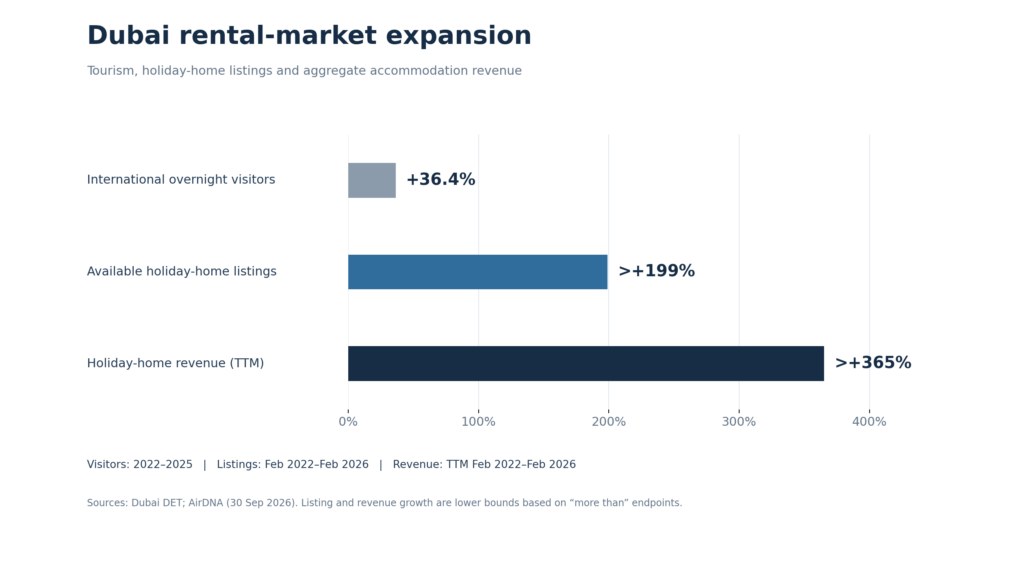
Notably, international overnight visitors increased from 14.4 million in 2022 to 19.6 million in 2025, representing a growth of approximately 36% (Source: Dubai Department of Economy and Tourism).
Yet, the holiday-home market segment expanded even more rapidly in terms of available stock.
AirDNA reports that the average number of monthly available short-term rental listings increased from approximately 10,700 in February 2022 to more than 32,000 in February 2026.
Importantly, this expansion was accompanied by significant growth in total market revenue. Data provider AirDNA reports an increase of the trailing twelve-month short-term rental revenue from approximately USD 215 million to more than USD 1 billion over the same period.
The market was therefore not simply experiencing an increase in supply. The expansion in available accommodation was accompanied by even stronger growth in aggregate market revenue. While this does not necessarily imply a corresponding increase in occupancy or profitability at an individual property level, it is evidence of the exceptional market growth during this phase.
Meanwhile, Dubai’s long-term residential rental market experienced an exceptional period of rent increases.
Our analysis of Dubai Land Department (DLD/Ejari) rental contract data between 2022 and 2025 indicates that median annual rents for newly registered one-bedroom apartment leases increased significantly across established residential communities.
For owners operating holiday homes, a significant advantage during this period was the model`s flexibility.
Short-term rental rates could be adjusted dynamically, whereas existing annual leases are subject to contractual commitments and compliance with Dubai’s rental index.
While this flexibility represents a significant advantage in an environment of rapidly rising residential rents, it also exposed owners more directly to fluctuations in tourism demand, competition and operating costs.
Supply Growth Meets Demand Shock
Along with the rapid expansion of Dubai’s holiday-home sector came a gradual change in its competitive environment.
With more owners and operators entering the market, attractive returns became increasingly dependent on the characteristics of the individual property and the quality of its operation.
Whereas location unsurprisingly remained important, pricing, presentation, guest reviews, distribution across booking platforms and operational efficiency became increasingly relevant.
The market`s evolution depicted beforehand was well underway before the exceptional regional events occurred early 2026.
The ensuing geopolitical crisis and its impact on regional travel induced a separate, external and profound demand shock.
According to AirDNA’s September 2026 analysis, approximately 350,000 accommodation nights were cancelled in March, compared with a pre-crisis monthly reference level of around 145,000.
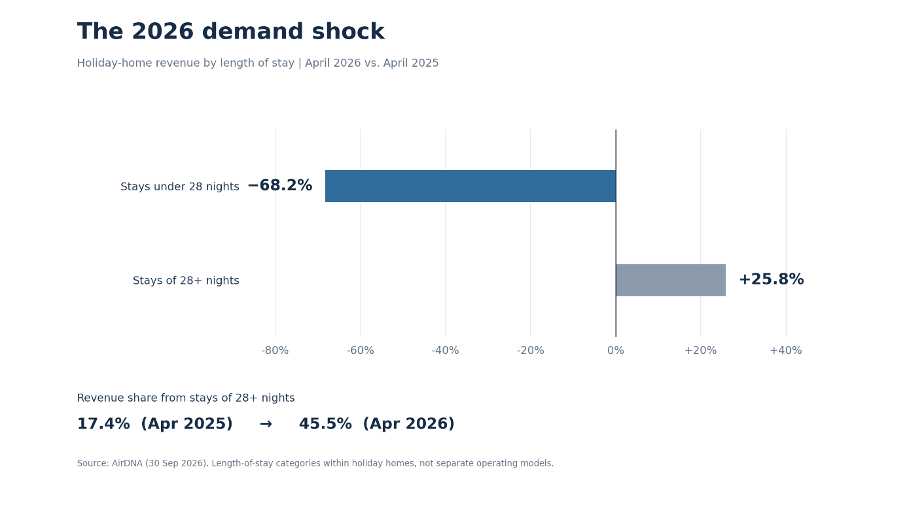
Short-term rental revenue subsequently declined by an estimated 68.2% year-on-year in April 2026.
These figures illustrate the substantial exposure of short-term accommodation to abrupt changes in international travel demand.
However, two developments need to be distinguished.
An expansion of holiday homes supply is a gradual change that influences competitive positioning – typically over several years. A sudden disruption to international travel on the other hand is an external demand shock, often exhibiting a very different duration and recovery profile.
Considered in isolation, neither development establishes that short-term rentals have permanently become less attractive.
What they do demonstrate clearly, however, is that holiday-home revenues are exposed to a different combination of risks compared to conventional long-term residential leases.
The Flexibility Card: A Partial Offset of Lost Tourism Demand
The 2026 disruption revealed another important insight into the relation between the two traditional rental models.
AirDNA reports that revenue from holiday-home stays of 28 nights or longer increased by 25.8% year-on-year in April 2026, even as revenue from shorter stays declined sharply.
In April 2026, revenue derived from such longer-term stays accounted for an estimated 45.5% of the combined revenue, compared with 17.4% one year earlier.
My plausible explanation lies in the behaviour of existing Dubai residents.
Faced with considerable uncertainty, some would have preferred the flexibility of furnished holiday-home accommodation over committing to another 12 months contract.
Such a shift would have provided an alternative source of demand for holiday-home operators at a time when international tourism was severely disrupted.
Evidently, this does not represent the establishment of a separate operating model. Rather, it illustrates how the existing holiday-home sector can accommodate different demand profiles, including temporary residential demand from within the UAE itself.
While the available data do not establish the proportion of which the increase was attributable to residents postponing annual lease renewals, the data suggests that this shift is likely to have partially offset the sharp decline in accommodation demand from international arrivals.
Meanwhile, it also highlights an important relation between the two rental markets: changes in tenant behaviour and residents`uncertainty can influence holiday-home occupancy, even when international tourism demand is weakening.
Our Analysis of Ejari Data and What It Reveals
To understand how the relative economics have changed, we examined residential rental contracts recorded by the Dubai Land Department.
Our analysis focused on newly registered (as opposed to renewals bound by the Dubai rental-index regulations) one-bedroom apartment leases in three established communities: Dubai Marina, Downtown Dubai and Business Bay.
The results illustrate both the scale of the earlier rental market expansion as well as the more recent change in trend.
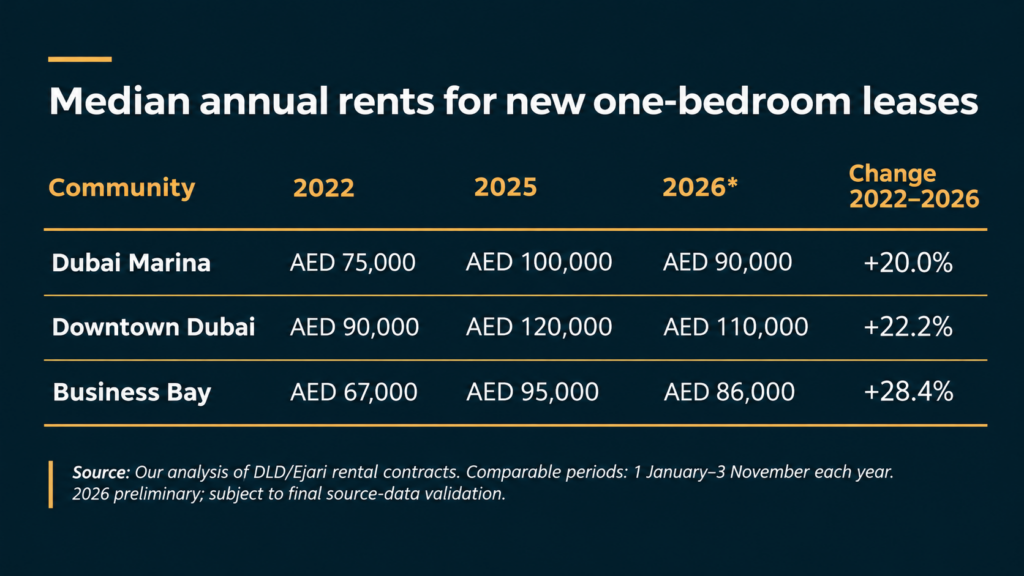
Source: Proprietary analysis of DLD/Ejari rental contract data. Median annualised rents for newly registered one-bedroom apartment leases (single-property contracts). Comparable periods: 1 January – 3 November of each year, 2022–2026.
Three observations are particularly relevant.
First, despite the recent moderation, newly contracted rents in all three communities remain approximately 20 – 30% above their 2022 levels.
Second, the direction of the market has changed.
Compared with the equivalent period in 2025, median new-lease rents in 2026 declined by 10.0% in Dubai Marina, 8.3% in Downtown Dubai and 9.5% in Business Bay.
Third, the difference between new-lease and renewal medians has narrowed considerably.
In Business Bay, the median new-lease rent exceeded the renewal median by approximately 18.8% in 2025, compared with just 3.6% in 2026.
For Dubai Marina, the difference between the two medians effectively disappeared.
These figures do not constitute a constant-quality rental price index as the properties represented in each year’s transactions are not necessarily identical, and new leases and renewals represent different contract populations.
Nevertheless, the consistency of the trend change across the three communities is worth noting.
For investors, however, the implications go far beyond the performance of long-term rentals themselves.
During the earlier phase of rapid rent increases, owners whose tenants voluntarily vacated their properties could often improve their income significantly by securing a new long-term tenancy at prevailing market rates.
That opportunity has become less pronounced as new-lease rents have moderated.
At the same time, lower long-term rental income reduces the income threshold that a short-term operation must exceed to become economically advantageous.
This is where the relationship between the two rental models becomes particularly interesting.
STR vs. LTR: Comparing the Economics Rather Than Headline Yields
With a short-term rental generating revenue only for nights that are actually booked, gross income depends on the achieved average daily rate (ADR) and actually booked nights throughout the year.
The owner must then account for management fees, platform commissions, utilities, cleaning and maintenance, furnishing and replacement costs, and other operating expenses.
Whereas a conventional annual lease typically provides far less cost overhead and a different allocation of operating responsibilities, owners nevertheless remain exposed to (limited) maintenance expenses, service charges, vacancy between tenancies and tenant-related risks.
The appropriate comparison is therefore between the realistic net income potential of both operating models for the same property, taking into account their respective risks, capital requirements and management intensity.
In the absence of reliable property-specific operating data, assumptions about the relative profitability of either model should be treated with caution.
Why Segmentation Matters More in Short-Term Rentals
Dubai’s residential market is becoming increasingly fragmented with respect to location, building quality, developer, community characteristics and property type.
This differentiation is especially relevant to short-term rentals.
Two apartments in the same community may have similar long-term rental values but significantly different holiday-home performance.
Views, layout, proximity to attractions, building facilities and established guest-review histories can influence the ability to attract bookings and command higher nightly rates.
The operating model therefore adds another layer of differentiation.
Our experience shows that factors like dynamic pricing, distribution and price management, responsiveness to guest enquiries, maintenance standards and the consistency of the guest experience can substantially affect revenue.
Long-term rental performance on the other hand hinges more on the quality-of-life aspects insofar as they are influenced by the building and its amenities, its management and surroundings (traffic, noise, leisure and other offerings, ease of access etc.).
Consequently, community-level averages can conceal considerable variation in short-term rental performance.
This is also why broad claims about the average profitability of Dubai holiday homes should be treated with caution, particularly when sourced from operators themselves or when the underlying data combine properties of different types, locations and sizes.
For investment decisions, therefore, a relevant comparison is not between two market-wide averages, but between the realistic net revenue potential of a specific property and its achievable alternative annual rent.
Outlook: The Variables Shaping the Next Cycle
Going forward, Dubai`s tourism demand will continue to be an important determinant of short-term rental performance, including the further evolution of the recovery following the disruption of 2026.
However, in parallel with an assumed future demand growth, the number of properties competing for short-term guests matters just as much. Upcoming residential stock and ongoing decisions by existing owners to switch between operating models will continue to affect available supply.
Likewise, the long-term segment will continue to evolve subject to factors such as population growth, employment, household size and the delivery of new residential stock.
That said, it is important to be aware of the fact that the two markets are connected.
In a market phase bringing about a notable decline in short-term rental profitability, owners may elect to turn to annual leasing, thus increasing supply in the long-term segment.
Conversely, in a situation of weakening long-term rents while tourism demand recovers, short-term letting may again become attractive for suitable properties.
These adjustments do not happen instantaneously. Decision lead times, furnishing and marketing requirements, contractual commitments, management arrangements and the regulations of individual buildings or communities can create practical barriers to switching.
Nevertheless, they illustrate why the relative economics should be considered dynamically and monitored continuously rather than be regarded as two separate, permanently fixed investment propositions.
Investment Implications: Rental Strategy as Part of Asset Management
Our own approach to rental strategy has evolved alongside the described market shifts.
During the earlier phase of Dubai`s ongoing cycle, suitable properties operated in short-term letting offered a compelling combination of income potential and flexibility.
As long-term rents rose sharply and the holiday-home sector became more competitive, securing attractive annual leases and thus relative stability became the more appropriate choice for many of the properties we advised on.
In fact, we had already been adjusting our recommendations to property owners in response to these changing market dynamics, well before the disruption of early 2026.
As the subsequent crisis was not realistically predictable, the change in the strategic approach was based solely on the relationship between achievable income, operating costs, competition and risk.
The same principle applies going forward.
A property that is best operated as a long-term rental today may warrant reconsideration as tourism demand, achievable nightly rates or conventional rents change.
Similarly, even an attractive short-term rental performance should not prevent an owner from reassessing whether a secure annual lease offers a better risk-adjusted outcome.
For investors, the ongoing assessment of the rental strategy should be an integral part of a broader asset management process, firmly integrated into financing, maintenance, capital expenditure and eventual disposal planning processes.
Rental strategy is not a static decision, but an indispensable part of managing a property’s performance throughout the investment cycle.
Sources and Methodology
Dubai tourism: Dubai Department of Economy and Tourism (DET), annual tourism performance reports, 2022–2025. International overnight visitor figures cover the overall tourism market and are not specific to holiday-home accommodation.
Short-term accommodation: AirDNA, Dubai Turns to Medium-Term Rentals as War Cuts Short-Term Demand, 30 September 2026. Figures concerning available listings, market revenue, cancellations and changes in stay duration are based on AirDNA’s market estimates.
Long-term rental research: Proprietary analysis of Dubai Land Department (DLD/Ejari) rental contract data. Median annualised rents for newly registered residential one-bedroom apartment leases, restricted to single-property contracts and counted by unique contract ID. Community classifications follow DLD administrative areas. Comparable observation periods: 1 January–3 November of each year, 2022–2026. Data cut: 3 November 2026.